Fiber Internet: What is it and How Does it Work?
Why Loveland Residents are Choosing Fiber Internet
As internet use continues to grow, people have started to hear more about the power of fiber internet. But what is it, and why is it considered the new standard for connectivity? Unlike traditional copper networks, fiber uses ultra-thin strands of glass to transmit data at high speeds with exceptional reliability. After decades of development, it can now power everything from remote work and streaming to gaming and smart home devices. Understanding how fiber works helps explain why so many communities, including ours, are investing in it for the future.
What is fiber’s history?
Fiber internet may feel like a modern invention, but the technology dates back to over half a century. Early, practical experiments of transmitting images through strands of glass began in the 1950s. By the late 1970s, researchers recognized that digital communications sent over fiber could transform telecommunications thanks to its remarkable speed and efficiency. It wasn’t until the early 2000s that fiber internet saw widespread adoption across the United States with cities and service providers investing heavily to meet the growing demand for high-speed connection. With most households becoming increasingly reliant on internet for work, school, and entertainment, fiber emerged as the technology capable of supporting the nation’s current and future digital landscape. But what exactly is fiber, and how does it work?
What is the technology behind fiber internet?
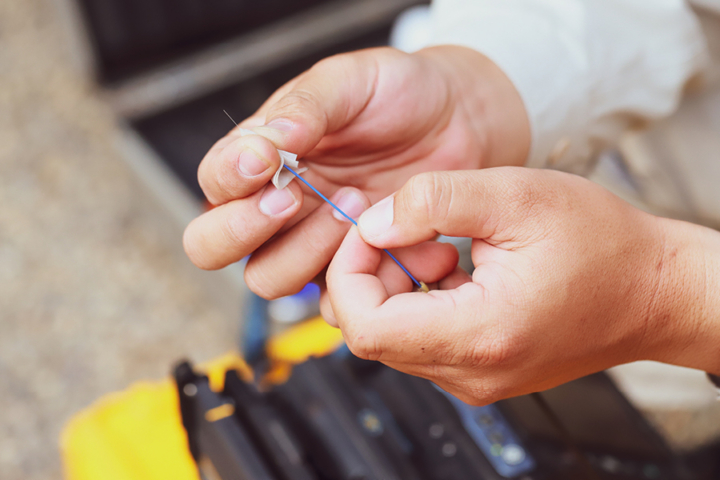
Fiber lines consist of three main layers: a glass core, a layer of cladding, and a color coating. The core is an extremely thin strand of silica glass 9 microns in diameter—that’s smaller than the width of a human hair. Surrounding this core is the cladding, another layer of glass that measures 125 microns in diameter. Both layers are surrounded by a colored coating that is 250 microns in diameter. Each layer plays a critical role in the strength, performance, and reliability of the fiber.
To transmit data, a laser travels through the fiber’s core and switches on and off in rapid pulses of binary code. This laser turns on a billion times per second and moves signals at an incredible 124,000 miles per second. The cladding causes the waveforms inside the core to bounce against it and refract, allowing the light to stay contained and travel long distances: approximately 60 miles of fiber line. Compared to traditional copper cables, this represents a major leap forward in technology. For example, fiber can transmit the entire Library of Congress from New York to San Francisco in a fraction of a second, while copper would take approximately six seconds to deliver the same amount of data.
The outer layer of fiber, the colored coating, is typically made of plastic and protects the glass layers from being damaged. This design allows fiber lines to bend without breaking, and they exhibit eight times the pulling strength of traditional copper wires. Combined with their resistance to weather, fiber lines are extremely durable and reliable.
How does fiber compare to copper?
Compared to a standard copper internet, fiber offers significantly more advantages. With higher speeds and greater capacity, fiber supports a superior internet experience. Fiber internet offers unlimited data with no throttling, symmetrical upload and download speeds, and enhanced security. It’s also future proof, built to keep pace with tomorrow’s demands and support the way people live, work, and stream. As the world becomes increasingly dependent on fast, consistent internet, it’s essential connections perform as expected. Fiber can deliver that.
At Pulse, we’re committed to delivering the best internet experience possible. Plus, we have the added advantage of being Loveland’s only local provider. When you choose Pulse, you’re investing in both quality service and your community. Contact us today to learn more about what fiber is and how it can benefit your home.